4 June 2026 • Rhion Jones
UK-based commentator, Rhion Jones (The Consultation GuRU) advises Publiq – a Company based in the Netherlands – but active in many countries. Here, he provides a uniquely British perspective on the case for investing in community dialogue.


With most infrastructure projects of importance in the UK, there is normally a substantial lead-time. Indeed, the general complaint is that we take far too long, and successive Governments have expressed their frustration. They describe our planning system as ‘sclerotic’ or worse, and the current Prime Minister has personalised it. Those who object, he regards as ‘blockers’!
But, provided ‘consent’ is given, sooner or later, construction starts. We use the historic image of shovels in the ground though a noisy mechanical digger is more likely to appear! Good news for the nation, maybe. But bad news for those whose lives are about to be disrupted, possibly for years.
Most of us will feel a degree of sympathy for those caught up in this unwelcome situation. No-one wants the disruption, the noise, the dust, vibration or the traffic movements. Those feeling the full force of the project may, of course, be re-housed. Others, however, are not quite proximate enough to be moved, but close enough to have their lives seriously impacted. Even more people may live slightly further away, and yet be substantially affected. For larger projects, it is seldom one site but several -each possessed of its own cocktail of consequences.
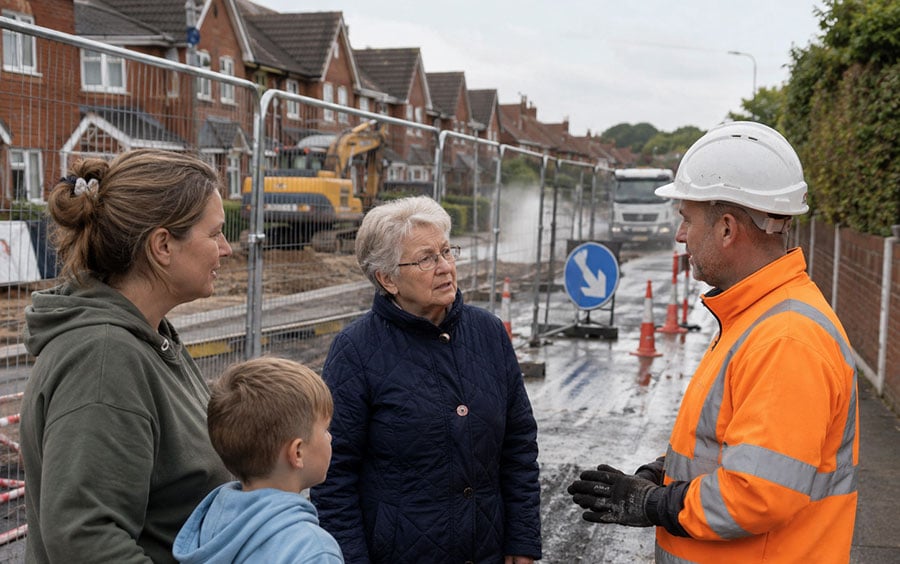
Large construction companies are all well aware of the issues and have a range of tools and techniques that can mitigate the worst effects of building. The philosophy of enforcement may differ in various countries, but nowhere would infrastructure builders expect to avoid huge consequences if they break the (local) rules. The extremely litigious USA environment means that non-compliant builders will expect be in court. European models differ and are often based on observance of industry Codes of Practice and third-party self-regulation such as the UK’s Considerate Constructors Scheme.
The Scheme has three main pillars:
For each of these there is a separate site-specific assessment made by independent Monitors, and without doubt, compliance with a range of excellent best practice standards should go some way towards community confidence in the building contractors.
Meeting generic standards is one thing; reaching out to an affected population and meeting their expectations is quite another. These will have been formed over the years when the proposal was on a long journey from concept to consent, and subject, no doubt to the ups and downs of campaigns and consultation. Various assurances will have been given about almost everything from tools to timescales and there will have been agreements of varying levels of formality with local authorities, local businesses or amenity groups.
In reality, it can be a tremendous challenge. Military commanders recognise that even the most detailed plans ‘will not survive contact with the enemy’, and in the same way, in large construction projects, there are risks that what seems fine on paper will not always work as well in practice. The engineering may be totally robust, but the vicissitudes of weather, supply chains, labour resources and external events can cause unforeseen difficulties.
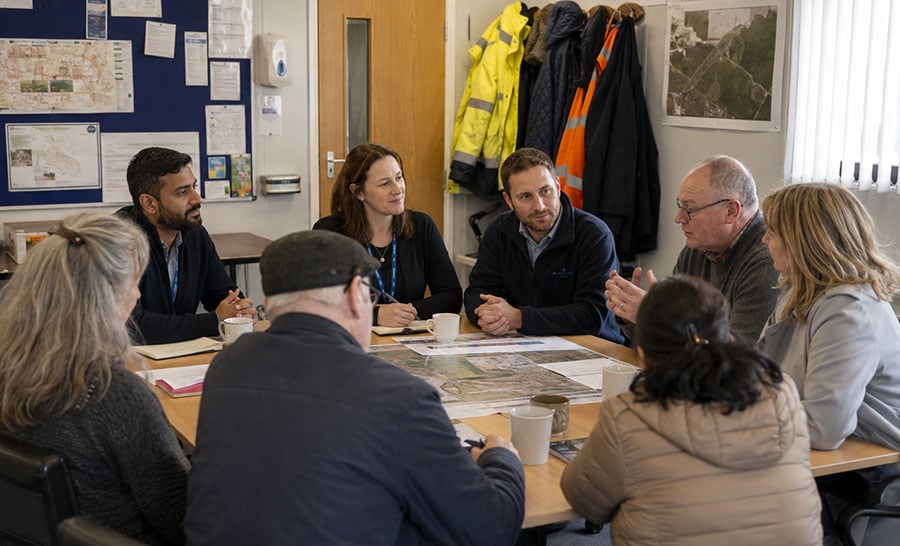
Anyone who read Sally Gimson’s excellent account of the HS2 project (Off the Rails, published in 2025) will recognise how often concessions and changes made in the planning phase of high-profile controversial linear projects have knock-on effects well into the construction phase. Assurances given, and conditions accepted in good faith when gaining consent was the primary focus – can suddenly look less sensible when speed of construction and minimising the period of inconvenience become the priority.
It makes the handover between the planners and the builders critical. The former should have allowed enough flexibility for host communities to work with construction firms to arrive at least worst solutions to the inconvenience issues. The latter must be fully aware of whatever assurances were given to local people and to honour them in principle and in practice. Nothing will work 100% and there needs to be a reservoir of goodwill with which to lubricate the relationship.
All this is the core challenge of those who work in the often-unsung role of community liaison. Or should it be community dialogue?
The term community liaison has been around for a long time and was endorsed by the International Finance Corporation as an important way to handle relevant issues almost twenty years ago. It needs well-informed people on hand to act as a focal point for communication with local people and interest groups. Inevitably, they can be seen as someone representing the project and acting as a spokesperson on its behalf. They may perform a conscientious role in gathering feedback and processing key issues dispassionately, but may be viewed by local people as a reactive ‘gatekeeper’ with little real power or authority to change very much.
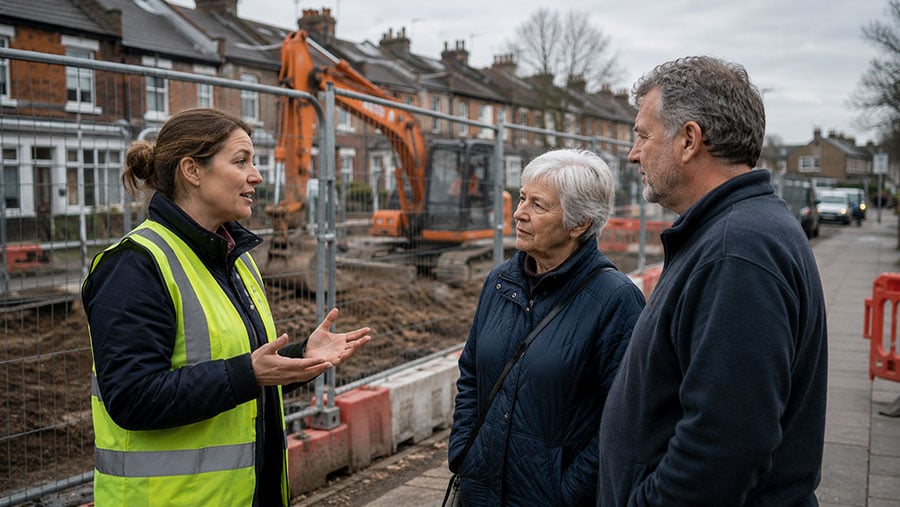
Community dialogue is a wider – and more senior role, closer to a partnership model. In this case, the relationship and communication flows are deliberately structured to be bi-directional with a collaborative principle underpinning the process. It needs Managers with more authority and more discretion, and able to develop a long-term basis of trust. Concepts such as the ‘social licence to operate’ have recently brought this approach to greater prominence and industry leaders in many countries are investing in this more transparent – and less transactional concept.
Regardless of which terminology is used – or even the scale of the activity, what matters most is probably the selection and appointment of good, experienced people to work with affected communities. The required skills-set is demanding with industry knowledge matched by the ability to work empathetically with a wide range of organisations and individuals with very different perspectives. Local knowledge also matters – sometimes immensely so as when dealing with cultural, linguistic, religious or ethnic groups.
It is also increasingly critical to give them the tools to do the job. Facebook pages and other social media, whilst useful, create as many problems as they solve and this is why Publiq’s easily accessible and cost-effective solution can be so appropriate.
When shovels start digging the ground, success can often depend upon what is less visible. The ‘dialogue’ in the air contains all the thoughts, sentiments and issues in the minds of those whose lives are affected. Managing that ‘air quality’ is an enormous responsibility and a challenge.

The UK's Consultation Guru; Joint-author of 'The Politics of Consultation' (July2018) & Founder Director at The Consultation Institute (tCI) (2003-2022).
Reach out to us
Concepteurs BVDownload our app


2026 Publiq. All right reserved.


